
Home › Our work › AI Business Intelligence
Our work / AI Business Intelligence
A system that reads your whole network, every day, and answers your questions
A manufacturer sits in the middle of a commercial network it cannot fully see: vendors, customers, competitors, all connected, all moving. This is the kind of system we build to make that network legible, and every claim it makes comes with a citation behind it.
The problem this solves
Ask a manufacturer who their customers are, and you get a fast, clean answer.
It gets slower from there. Who are those customers’ competitors? Which vendor just got acquired? Which customer announced a plant expansion last month? Are two names on the approved-supplier list actually the same company? Answering any of these can cost someone a week.
The information is not hidden. It is in company registries, trade press, filings and press releases. The problem is not access. It is that nobody has time to read all of it, and there is nowhere to go and simply find out.
That is the job: make a sector understandable, without making anyone read all the news themselves.
What we build
The system has two halves. Keeping them separate is what makes it trustworthy.
Part one: a knowledge graph. Every company in the picture is a node, seeded from registry data with identifiers, addresses and corporate parents, then extended with the company’s own vendor, customer and competitor lists. The links between them are typed, and the ones checked by hand are the standard everything else gets measured against.
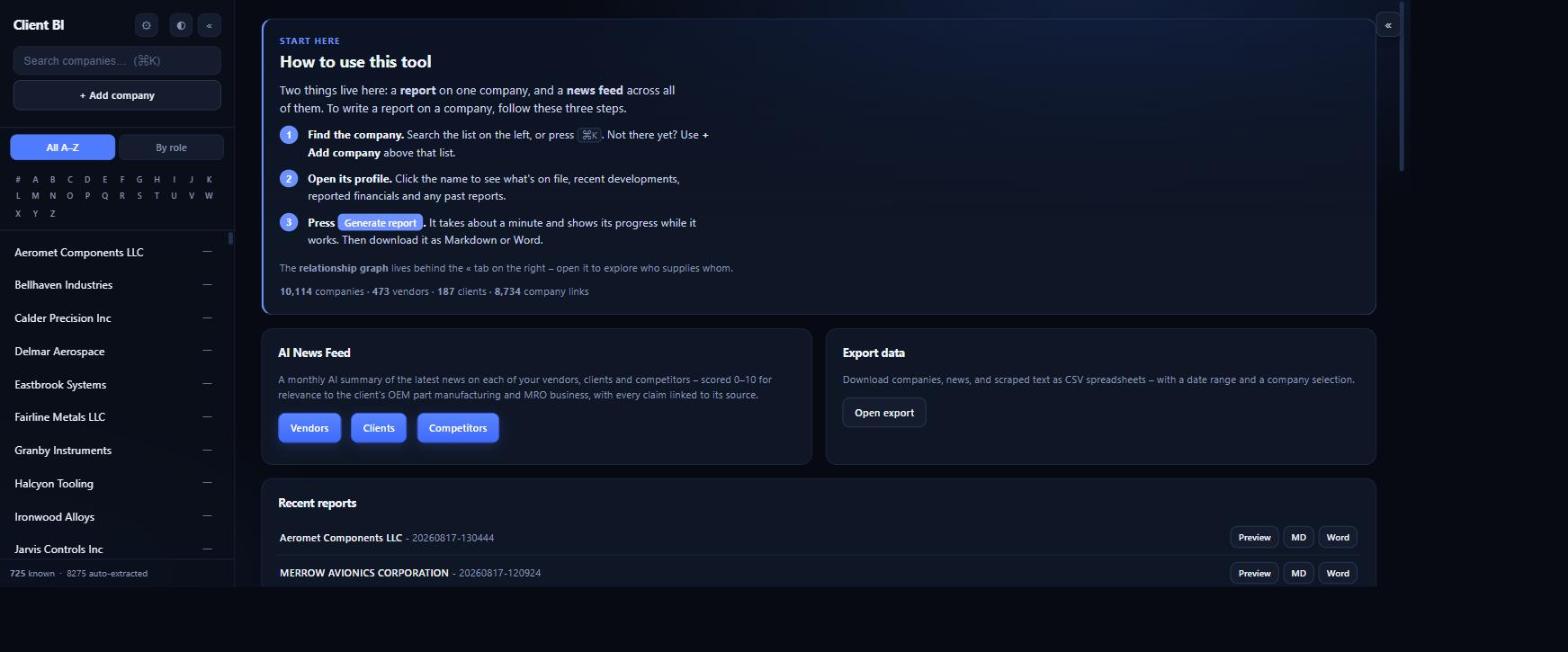
Part two: retrieval. A scheduler works through the vendor and customer lists on a rotation, pulls sector news for each name, and files every article as a source document attached to the companies it mentions. When you ask the system a question, it finds the passages that actually bear on it and answers from those, quoting them back to you.
Why you can trust what it tells you
This is what people ask about first, and rightly so. Three rules do most of the work.
A relationship needs a verbatim quote. If the system decides company A supplies company B, it has to find and show the exact sentence in an article that says so. No quote, no relationship drawn. This one rule covers most of what people worry about with AI, that it will simply make things up.
Company names get matched carefully. A company mentioned in an article is checked against the known list in a strict order: known alias first, then exact match, then close match, and only then a constrained AI guess, and most importantly, one that can also say “I don’t know.” Once a name is matched, the system remembers it, so it does not have to work it out again next time.
Structured facts come straight from the graph. A company’s identifiers, address, corporate parent and relationship to you are read directly out of stored properties. The language model writes prose about those facts. The graph is what knows them.
A fourth rule is really a design stance: the system is allowed to say it does not know. Derived conclusions, such as a likely second-tier supply relationship or a probable competitor inferred from a shared customer, are drawn as dashed lines and labelled with the rule that produced them. They are offered as leads to check.
What it is like to use
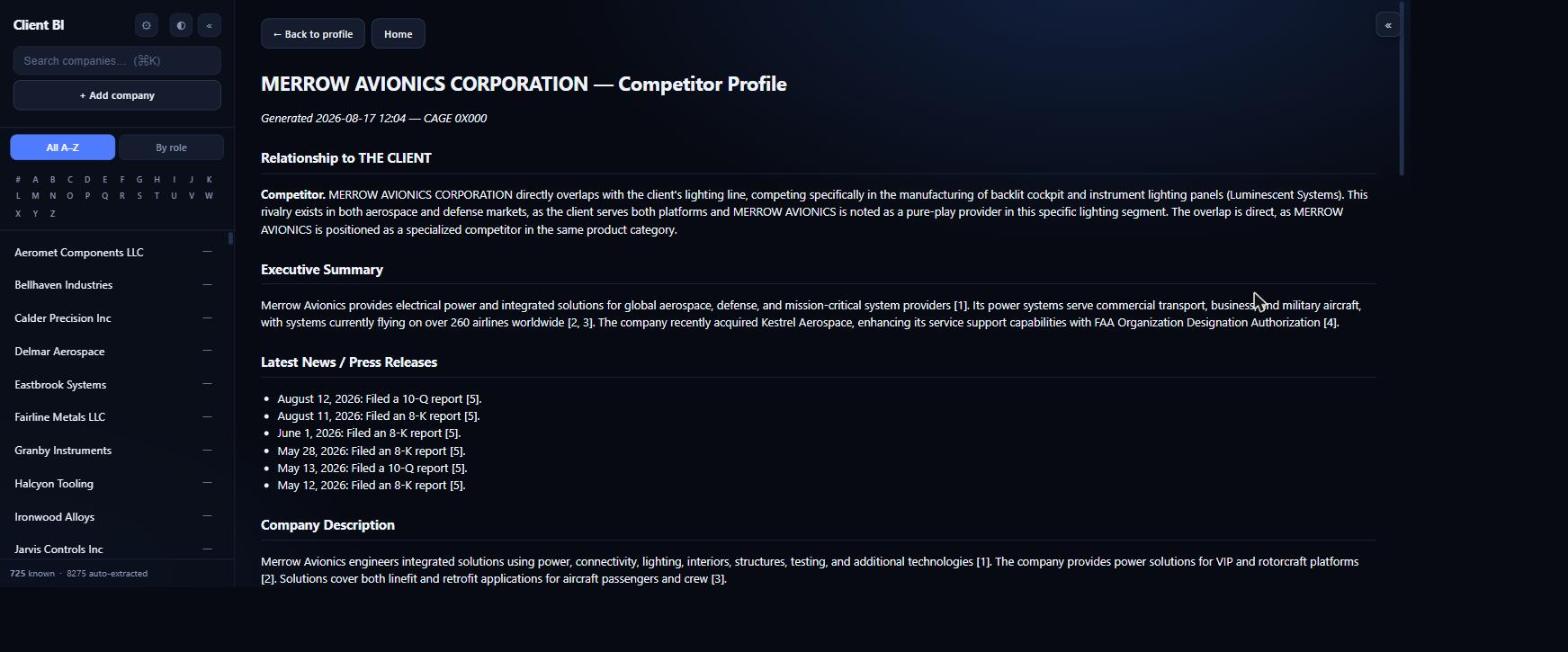
You open the graph and click on a company. You get a profile: the relationship first (customer or vendor, since when, current status), then recent news as short cards (topic, a quote, why it matters), then contact details, then how that company compares to your own position.
Below all that is a simple search box. Type something like what happened with this supplier’s new programme? and it answers from articles it has actually read, with links attached. Reports can be saved as documents. Companies, news and extracted text can be exported as a spreadsheet over any date range, so it can feed a CRM and turn into a call list.
The valuable output is the ten minutes on Monday morning when somebody finds out a customer’s parent company changed, in time for the sales call.
Where it runs
We host and maintain the server. The graph database, the application and the language model all run in containers. That means the whole system moves as one piece, and setting it up in a new environment takes one deployment, not a rebuild.
Cloud infrastructure and the deployment pipeline are part of what we deliver: sizing the server, setting up security certificates, putting everything behind authentication, and keeping updates simple enough that a model change or a schema update does not cause downtime.
Where the data has to stay in-house, the same setup runs on a single workstation GPU on your own hardware. That is often the condition for a project like this to happen at all, so it is built to run either way from the same code.